The Building Cost Information Service (BCIS) is the leading provider of cost and carbon data to the UK built environment. Over 4,000 subscribing consultants, clients and contractors use BCIS products to control costs, manage budgets, mitigate risk and improve project performance.
Published: 13/08/2026
The Office for National Statistics (ONS) publishes quarterly data(1) measuring the value and volume of main contractors’ new orders in Great Britain by sector and type of work. Its intention is to provide a forward-looking snapshot of both current confidence and potential future activity in the construction industry.
New orders decline persists in second quarter
Total construction new orders fell by 11.9% in 2Q2026 compared with 1Q2026, with £9.2 billion of work committed, according to the latest ONS data. On an annual basis, new orders were down by 18.1% and were also 16.4% below their level in pre-pandemic 2019.
No sector recorded an increase in new orders between the first and second quarters. The steepest fall was seen in new orders excluding housing and infrastructure, where orders contracted by 22.0%.
Compared with 2Q2025, private industrial new orders experienced the strongest growth, rising by 33.1%. In contrast, new orders excluding housing and infrastructure saw the sharpest decline, falling by 45.8%, followed by a 28.5% decrease in private commercial new orders.
Dr David Crosthwaite, chief economist at BCIS, said: ‘The latest new orders data reinforce the weakness we’re seeing across the construction market, with new orders down on the quarter and the year in the second quarter.
‘There are some positives in the data, including a 12.9% annual increase in new orders for private housing, but these are outweighed by substantial declines elsewhere, including in public housing, infrastructure and private commercial work. It’s increasingly clear that the reduced investment appetite for new construction is not isolated or a short-term issue.
‘This raises a significant question for the new government: how will it rise to the challenge and help recover that appetite? The construction industry entered 2026 expecting some degree of recovery, but so far that has not materialised. The question now is whether government allows these conditions to persist or takes action to strengthen confidence and improve the appetite for investment.
‘If we continue to see a sustained downturn in activity and future demand, there is a real risk that the consequences become more pronounced. Prolonged weakness could put further pressure on already stretched supply chains, contribute to a spike in insolvencies and ultimately cause longer-term damage to capacity across the construction industry.
‘That would be directly counterproductive for wider economic growth, which apparently remains a central government priority. Growth ultimately gives the government greater capacity to make decisions that improve living standards and strengthen the UK’s economic resilience. Construction has an integral role in that future, and the government cannot afford to overlook it.’
| Sector | New orders in 2Q2026 compared with | |
| 1Q2026 | 2Q2025 | |
| Housing public | -2.1% | -19.1% |
| Housing private | -3.7% | 12.9% |
| Infrastructure | -5.1% | -22.5% |
| Public – other new work | -22.0% | -45.8% |
| Private industrial | -10.1% | 33.1% |
| Private commercial | -21.0% | -28.5% |
| All new work | -11.9% | -18.1% |
Source: ONS – New orders in the construction industry, Table 2
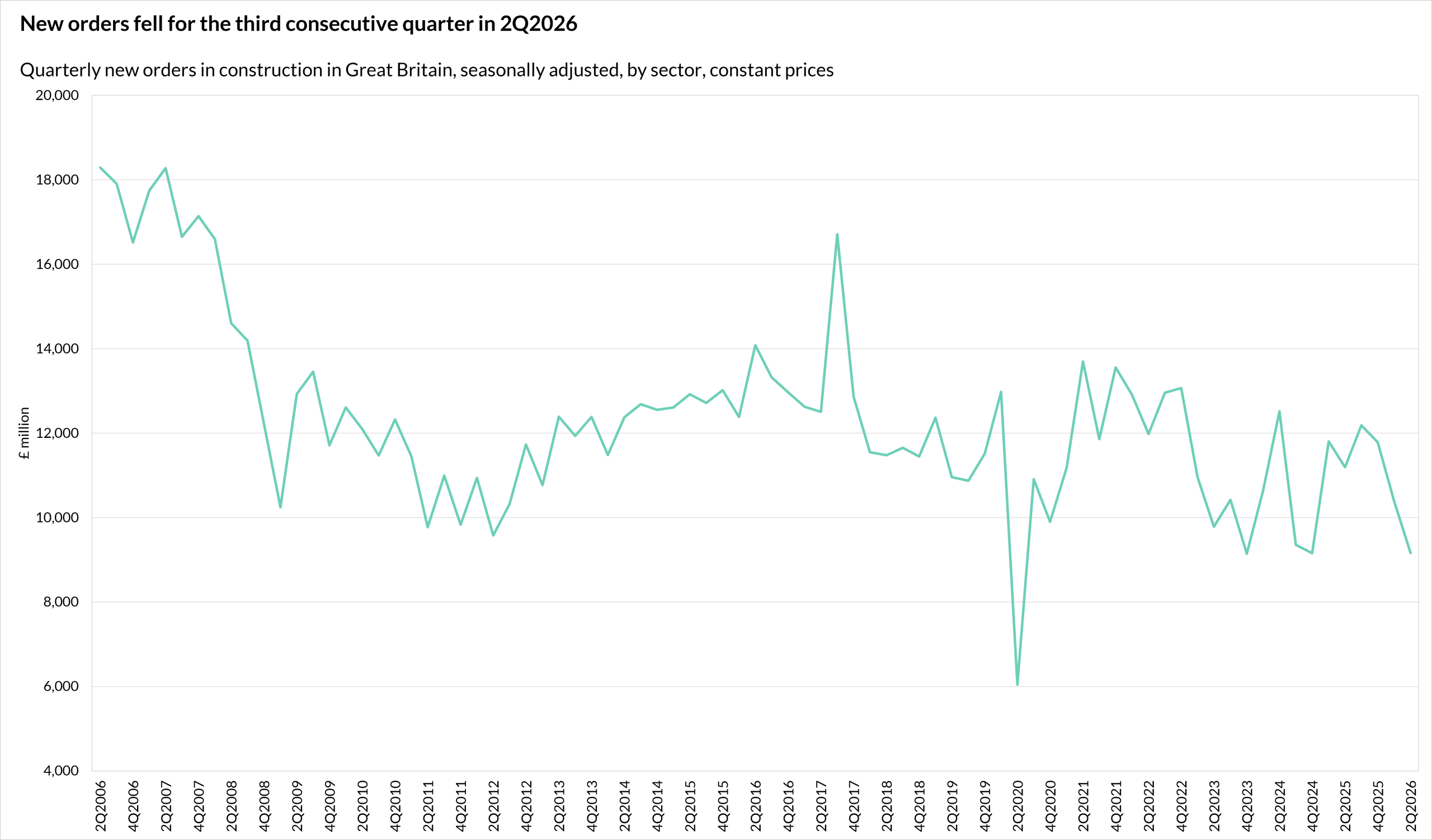
Source: ONS – New orders in the construction industry, Table 2
To keep up to date with the latest industry news and insights from BCIS, register for our newsletter here.
(1) Office for National Statistics – New orders in the construction industry - here