The Building Cost Information Service (BCIS) is the leading provider of cost and carbon data to the UK built environment. Over 4,000 subscribing consultants, clients and contractors use BCIS products to control costs, manage budgets, mitigate risk and improve project performance. If you would like to speak with the team call us +44 0330 341 1000, email contactbcis@bcis.co.uk or fill in our demonstration form
Published: 13/08/2026
The Office for National Statistics (ONS) publishes monthly estimates of the amount of construction output chargeable to customers for building and civil engineering work in Great Britain, split by sector and type of work(1).
New work contraction continues to drag down construction output
Construction output increased by 0.3% between 1Q2026 and 2Q2026, according to the latest data from ONS. Compared with the same quarter in 2025, output in 2Q2026 was down by 2.0%.
New work increased by 0.4% on the quarter but fared less well on the year, falling by 6.1%.
Meanwhile, R&M output increased by 0.2% between 1Q2026 and 2Q2026, and by 3.9% on the year.
In new work, the greatest quarterly movements were a 4.1% fall in public new housing output and a 3.4% decrease in public non-housing new work, which includes health and education projects.
On the year, all new work sectors, with the exception of private commercial, experienced a decline in output. The steepest fall was a 14.8% decline in public housing output. Conversely, annual growth was recorded across both public housing and private housing R&M, with increases of 3.7% and 5.4% respectively.
| Sector | Change 2Q2026 compared with | |
| 1Q2026 | 2Q2025 | |
| New work | ||
| Public housing | -4.1% | -14.8% |
| Private housing | 1.1% | -6.7% |
| Infrastructure | 1.9% | -6.8% |
| Public non-housing | -3.4% | -4.2% |
| Private industrial | -2.6% | -11.8% |
| Private commercial | 2.0% | 0.8% |
| All new work | 0.4% | -6.1% |
| Repair and maintenance | ||
| Public housing | 2.5% | 3.7% |
| Private housing | -0.6% | 5.4% |
| Non-housing | 0.4% | 2.6% |
| All R&M | 0.2% | 3.9% |
| All work | 0.3% | -2.0% |
Source: ONS – Output in the construction industry, Table 2a
Construction’s 0.3% growth contributed to 0.4% growth in GDP overall in 2Q2026. Output in the services sector increased by 0.5% while production output showed no growth (2).
Dr David Crosthwaite, chief economist at BCIS, said: ‘What’s evident from the latest ONS data release is the marked contraction in new construction work this year. Since 4Q2025, new work has fallen in each quarter compared with the same period a year earlier. The trend is also clear in the monthly data, with new work output contracting year-on-year for nine consecutive months as of June.
‘This continues to reflect several conditions. First, the economy remains stagnant, as a result of well-reported pressures, including the uncertainty arising from the conflict in the Middle East and its impact on client and investor confidence. Reduced new work ultimately means reduced investment in fixed capital.
‘Another notable takeaway is what’s driving that contraction. Monthly new housing output remains a weak point in the construction market across both the public and private sectors, with output contracting year-on-year for the past six and eight months respectively. Sustained contraction is also evident in infrastructure.
‘We should certainly recognise the resilience of the industry given supply chain disruption, renewed inflationary pressures and soft demand seen in the first half of 2026. Looking ahead, it’s essential the new government administration sets a stronger course. New construction is particularly important for economic growth because its impact extends well beyond individual sectors, supporting activity across a wide network of suppliers and businesses.
‘The Autumn Budget must therefore be a vehicle for incentivising investment and restoring business confidence. The data are clear: for many areas of construction, the main challenge is increasingly the lack of certainty over future demand.’
On a monthly basis, data for June 2026 show construction output decreased by 0.1% on May and by 2.3% on the volume in June 2025. New work was down by 0.3% and 5.9% on the month and year, while R&M output recorded no monthly growth and an annual increase of 2.8%.
In new work, the most significant monthly changes in output were recorded in public housing, down by 11.0%, and public non-housing, down by 2.8%. Meanwhile, public and private housing R&M output both increased on the month, by 1.8% and 1.3% respectively.
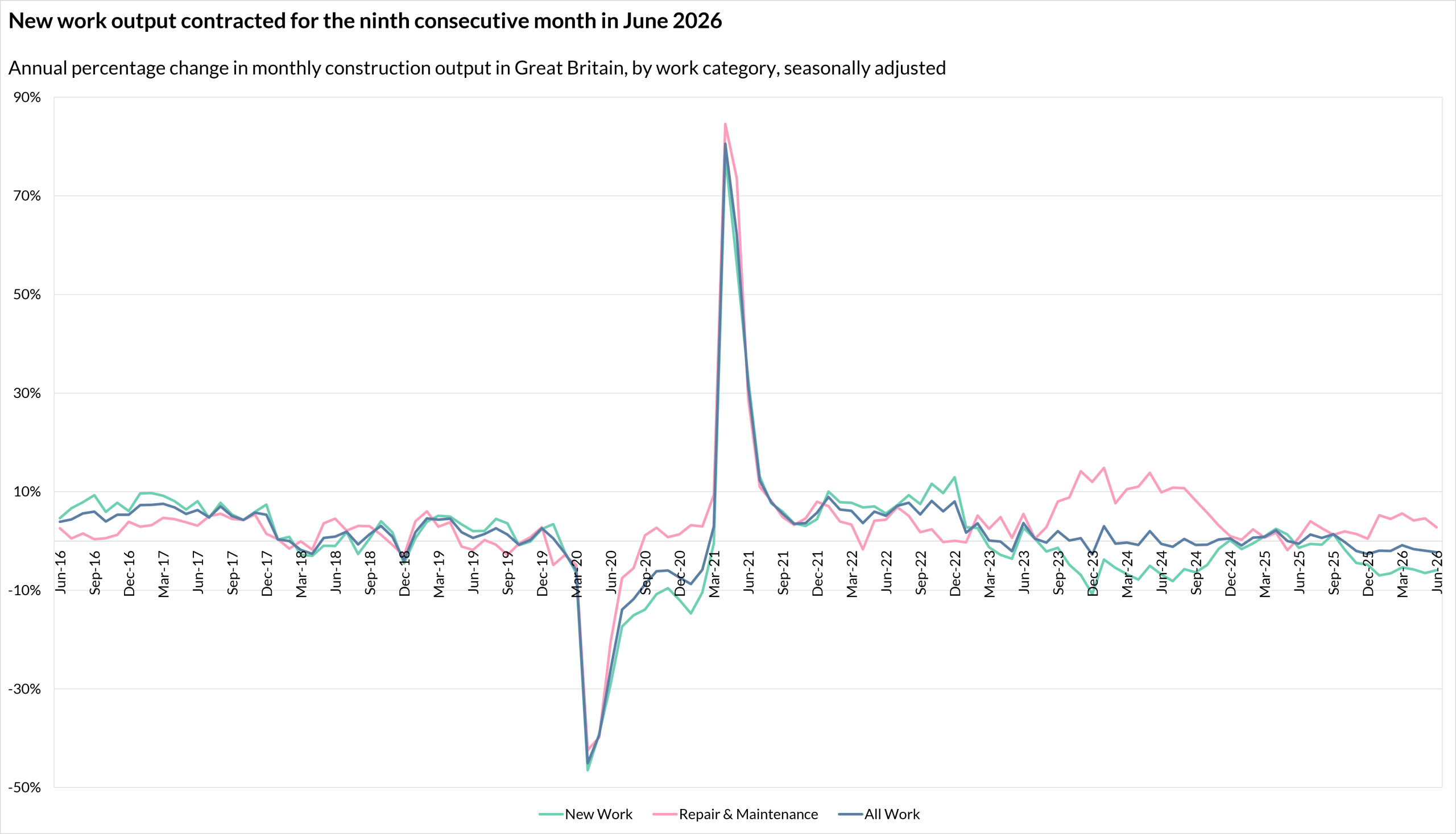
Source: ONS – Output in the construction industry, Table 2a
| Sector | Output in June 2026 compared with | |
| May 2026 | June 2025 | |
| New work | ||
| Public housing | -11.0% | -20.6% |
| Private housing | 0.1% | -5.7% |
| Infrastructure | 1.6% | -5.1% |
| Public other | -2.8% | -7.3% |
| Private industrial | 1.3% | -12.3% |
| Private commercial | 1.0% | 1.9% |
| All new work | -0.3% | -5.9% |
| Repair and maintenance | ||
| Public housing | 1.8% | 11.5% |
| Private housing | 1.3% | 2.3% |
| Non-housing | -1.5% | 1.3% |
| All R&M | 0.0% | 2.8% |
| All work | -0.1% | -2.3% |
Source: ONS – Output in the construction industry, Table 2a
To keep up to date with the latest industry news and insights from BCIS, register for our newsletter here.
(1) Office for National Statistics – Output in the construction industry - here